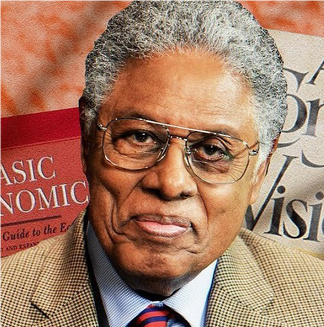
托馬斯·索維爾
芝加哥經(jīng)濟(jì)學(xué)派的代表人物之一
The most basic question is not what is best, but who shall decide what is best.
Life does not ask what we want. It presents us with options.
The problem isn't that Johnny can't read. The problem isn't even that Johnny can't think. The problem is that Johnny doesn't know what thinking is; he confuses it with feeling.
Mistakes can be corrected by those who pay attention to facts but dogmatism will not be corrected by those who are wedded to a vision.
One of the first things taught in introductory statistics textbooks is that correlation is not causation. It is also one of the first things forgotten.
People who decry the fact that businesses are in business "just to make money" seldom understand the implications of what they are saying. You make money by doing what other people want, not what you want.
Prices are important not because money is considered paramount but because prices are a fast and effective conveyor of information through a vast society in which fragmented knowledge must be coordinated.
A shortage is a sign that somebody is keeping the price artificially lower than it would be if supply and demand were allowed to operate freely.
The first lesson of economics is scarcity: There is never enough of anything to satisfy all those who want it. The first lesson of politics is to disregard the first lesson of economics.
政策與運(yùn)動(dòng)的區(qū)別在于政策由其結(jié)果來判定,而運(yùn)動(dòng)則由它能讓參加者感覺良好的程度來判定。
有時(shí)看前來像是解決方案比問題多。仔細(xì)觀瞧,今天的很多問題都是昨天的解決方案帶來的結(jié)果。
讀報(bào)或者看電視新聞時(shí),總是難免碰上一個(gè)又一個(gè)的為社會(huì)問題的解決提供了新的解決方案的人。
那些自認(rèn)為被上天選中的人們不喜歡談及痛苦的取舍抉擇。他們喜歡談?wù)撔腋8袧M滿的解決方案,從而可以根除整個(gè)的問題,至少在他們的想象里。
沒有解決方案。只有取舍選擇。
行人似乎永遠(yuǎn)沒有意識(shí)到他們對(duì)于汽車的安全而言是一種威脅。
如果它能夠用某種方式讓人自我感覺特殊和重要,可以說沒有任何想法會(huì)顯得荒唐而不可接受,甚至是對(duì)智力超凡和教育程度超強(qiáng)的人而言亦是如此。有些人將這種感覺與理想主義混為一談。
知識(shí)分子中最大的一些身份錯(cuò)亂就是他們很難記得住自己不是上帝。
很多高明人士經(jīng)常聳人聽聞地聲稱的所謂“真實(shí)世界的復(fù)雜性”實(shí)際上不過是他們自己腦子里的自相矛盾。
科學(xué)與技術(shù)的進(jìn)步并不意味著大多數(shù)人生活中智識(shí)復(fù)雜度的增加。通常恰好相反。
長(zhǎng)期而言,最嚴(yán)酷的大規(guī)模殺傷性武器是愚蠢。