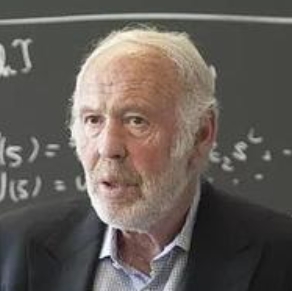
詹姆斯·西蒙斯
量化投資之父、量化之王
Trend-following is not such a good model. It’s simply eroded. Things change and being able to adjust is what made Mr. Simons so successful. “Statistic predictor signals erode over the next several years; it can be five years or 10 years. You have to keep coming up with new things because the market is against us. If you don’t keep getting better, you’re going to do worse.
We search through historical data looking for anomalous patterns that we would not expect to occur at random. Our scheme is to analyze data and markets to test for statistical significance and consistency over time. Once we find one, we test it for statistical significance and consistency over time. After we determine its validity, weask, ‘Does this correspond to some aspect of behavior that seems reasonable?’
We have three criteria. If it’s publicly traded, liquid and amenable to modeling, we trade it.
Luck, is largely responsible for my reputation for genius. I don’t walk into the office in the morning and say, ‘Am I smart today?’ I walk in and wonder, ‘Am I lucky today?’
Great people. Great infrastructure.Open environment. Get everyone compensated roughly based on the overall performance… That made a lot of money.
Efficient market theory is correct in that there are no gross inefficiencies, but we look at anomalies that may be small in size and brief in time.
Certain price patterns are nonrandom and will lead to a predictive effect.
Models can lower your risk…….. It reduces the daily aggravation. With old-fashioned stock picking: “One day you feel like a hero. The next day you feel like a goat. Either way, most of the time it’s just luck. “We don’t override the models.
有時我們利用的現(xiàn)象是特殊存在的。我們喜歡合理的波動性。在我們的工作中我們希望一些行動。"波動通常對我們有好處。我們沒有任何意義的信貸額度。我們不做大量的杠桿型融資。
我們不要從模型開始。我們要從數(shù)據(jù)開始。我們沒有任何先入為主的觀念。我們尋找那些可以重復(fù)數(shù)千次的東西。收斂性交易的問題是,你沒有時間尺度。你說最終都會收斂。好的,那何時是最終呢?
趨勢跟蹤不是一個好的模型。它只是被簡單地被沖刷了。"順應(yīng)事物變化和能夠進行調(diào)整是讓西蒙斯先生如此成功的原因。"在未來五到十年統(tǒng)計預(yù)測信號將削弱。你要不斷推出新的東西因為市場是對我們不利。如果你不保持越來越好,你只會更糟糕.——投資算法不能進步,就不是好算法。
我們通過歷史數(shù)據(jù)搜尋不被認為是隨機變動的異?,F(xiàn)象。我們的目的是要隨著時間變化分析數(shù)據(jù)和市場做統(tǒng)計學(xué)意義和一致性測試。一旦我們找到一個,我們會隨著時間推移測試它的一致性和統(tǒng)計學(xué)意義。我們確定它的有效性后,會問,“這符合某些方面似乎合理的行為嗎?——西蒙斯的方法論。
我們有三個標準。如果它公開交易,有流動性并且服從模型,我們就交易它。
很大程度上運氣是我有天才名譽的原因。在早上我不會走進辦公室說“今天我聰明嗎?,而是說,“今天我幸運嗎?——數(shù)學(xué)家相對于其他人來說最大的優(yōu)勢是,數(shù)學(xué)家深刻理解“概率。
厲害的人;厲害的設(shè)施;開放的環(huán)境。讓每個人基于整體表現(xiàn)獲得大致報酬,這能夠賺很多錢?!乃噺?fù)興公司的賺錢之道。
有效市場理論在不嚴重低效的市場中是正確的,但我們尋找的是短期、微小的異常現(xiàn)象。
某些價格形態(tài)并非隨機,而會有對預(yù)測的影響。
老式的選股策略:“有一天你感覺像個英雄,第二天你感覺像一只山羊,換種方式說,大多數(shù)情況下它是只是運氣?!?/div>
- «
- »